
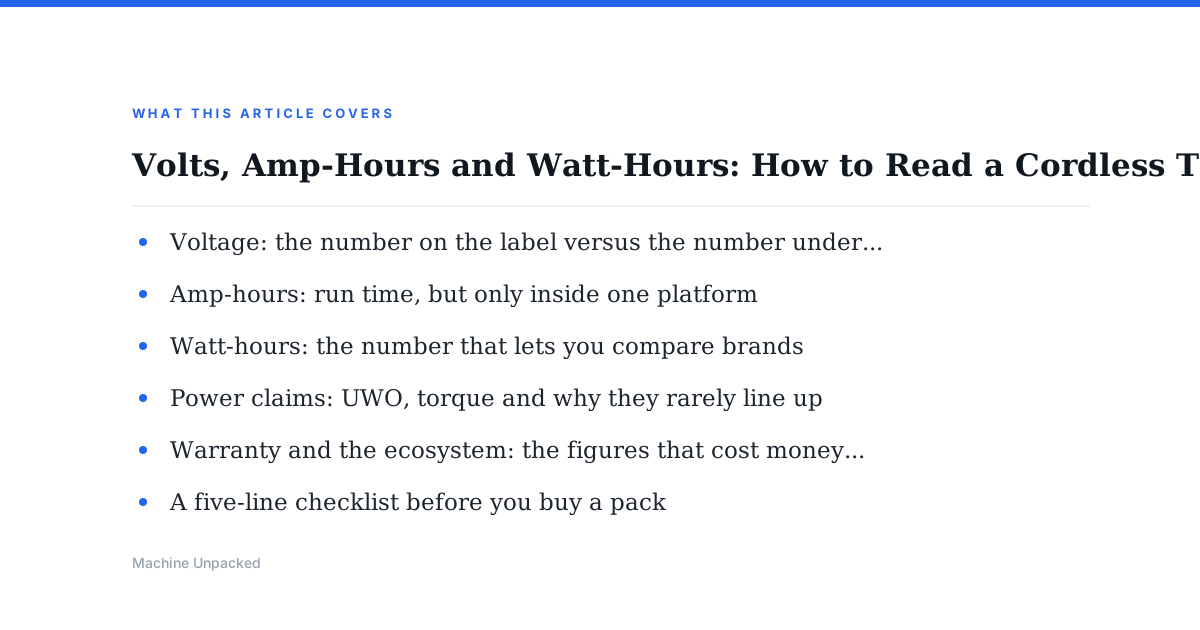
A cordless tool battery carries three numbers that matter and one that is mostly marketing. The voltage on the sticker is not always the voltage you get under load. The amp-hour figure tells you how long a pack runs, but only within one platform. The watt-hour figure, which most makers do not print, is the one that lets you compare across brands. This note walks through what each number means, what the manufacturers' own product pages say, and which figures to ignore. All figures below were read from the makers' official pages as of October 2026; where a maker does not publish a number, we say so rather than guess.
Voltage: the number on the label versus the number under load
DeWalt's own 20V MAX product pages carry a footnote worth reading in full: "Maximum initial battery voltage (measured without a workload) is 20 volts. Nominal voltage is 18." That is the manufacturer's wording, as of October 2026, on both the DCD771C2 drill kit page and the DCB205 5Ah battery page. In practice, a "20V MAX" pack and an "18V" pack from another brand are built from the same class of lithium cells arranged in the same five-cells-in-series layout. The 20 is a peak reading taken fresh off the charger with no load; the 18 is what the pack settles to when it is doing work.
Why this matters: a buyer comparing a DeWalt 20V MAX kit against a Milwaukee M18 or a Ryobi 18V ONE+ kit is not comparing a stronger battery to a weaker one. They are comparing three 18-volt-nominal platforms with different labelling conventions. The real differences between those kits live in the motor (brushed versus brushless), the electronics and the quality of the cells, not in the headline voltage. Where voltage genuinely changes the picture is between tiers: a 12V-class compact driver, an 18V-class general-purpose tool and a 40V, 56V or 80V-class outdoor tool are different animals, because higher voltage lets a motor pull the same power with less current and less heat.
Amp-hours: run time, but only inside one platform
The amp-hour (Ah) rating is a measure of capacity: how much current the pack can supply for how long. A 5.0Ah pack can nominally deliver 5 amps for one hour, or 10 amps for half an hour, before it needs charging. Milwaukee's page for its M18 XC 5.0 battery (model 48-11-1850) describes "5.0 amp-hours of runtime" and says the pack "delivers up to 2.5X more runtime, 20% more power and 2X more recharges than standard lithium-ion batteries." Note what that comparison is against: Milwaukee's own earlier packs, not a competitor's. DeWalt's DCB205 is likewise described simply as "5.0AH capacity." As of October 2026, neither page states a watt-hour figure or a pack weight.
The trap with amp-hours is comparing them across voltages. A 5.0Ah pack at 18V nominal and a 5.0Ah pack at 56V do not hold the same energy; the 56V pack holds roughly three times as much. Amp-hours are only a fair run-time comparison between packs on the same voltage platform. Within one platform they are useful: a 2.0Ah compact pack on a drill will be lighter and more comfortable overhead, while a 5.0Ah pack on the same tool will run longer and, on high-draw tools like circular saws, usually deliver more sustained power, because larger packs use more cells in parallel and each cell works less hard.
Watt-hours: the number that lets you compare brands
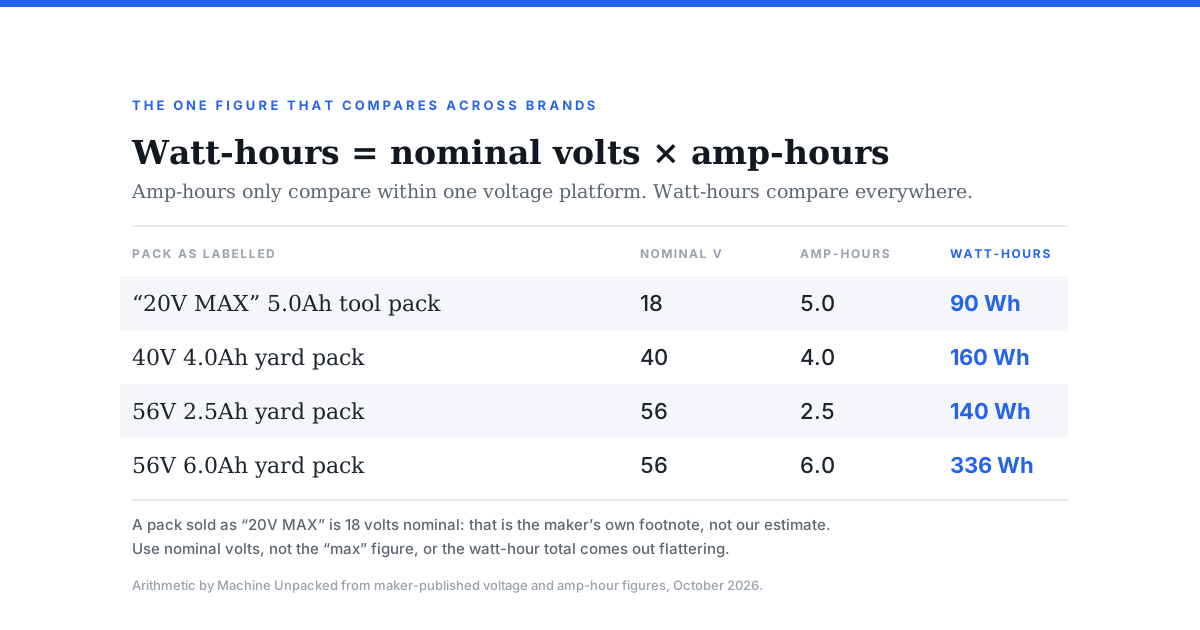
Watt-hours (Wh) is voltage multiplied by amp-hours, and it is the only figure that puts packs of different voltages on one scale. Using the nominal voltage the makers themselves print in their footnotes, an 18V 5.0Ah pack works out to 90Wh (18 times 5). A 56V 6.0Ah EGO pack, the size the company highlights on its homepage as of October 2026, works out to 336Wh (56 times 6). That arithmetic is ours; EGO, DeWalt and Milwaukee do not print watt-hours on the product pages we read. The number does appear in one place: the small transport-safety label on the pack itself, because packs above 100Wh fall under stricter airline carry-on rules.
Because a retailer's watt-hour figure is sometimes computed from the "max" voltage rather than the nominal one, do the maths yourself with the nominal figure if you want a conservative comparison. A pack marketed as "20V 5Ah" is 90Wh at 18V nominal, not 100Wh. The difference is small for one pack but adds up when deciding between, say, a hypothetical 40V 4.0Ah yard battery (160Wh) and a 56V 2.5Ah battery (140Wh). Higher watt-hours means more stored energy; it does not by itself mean the tool is more powerful, which depends on how fast the pack can release that energy and on the motor it feeds.
Power claims: UWO, torque and why they rarely line up
Drill makers do not agree on a power unit. DeWalt rates the DCD771 drill at "300 UWO," which stands for Unit Watts Out, a composite of speed and torque measured by DeWalt's own method; the same page lists two speed ranges, 0 to 450 and 0 to 1,500 RPM. Other brands publish inch-pounds of torque, often a "max" figure taken at stall, when the chuck is not turning at all. These figures are not interchangeable, and there is no neutral standard that makes a 300 UWO drill directly comparable to a 500 in-lb drill. The honest use of these numbers is within one brand's lineup, where the test method is at least consistent: a 300 UWO drill is less powerful than the same brand's 500 UWO drill, and that is all the number tells you.
For an actual purchase decision, the specifications that translate more reliably into daily use are chuck type and size (the DCD771 carries a 1/2-inch single-sleeve ratcheting chuck, per its page), brushless versus brushed motor, the number of clutch settings, and the battery sizes bundled in the kit. A brushless motor generally runs cooler and longer on the same pack than a brushed one, and that difference shows up in the price of the kit more reliably than any power unit does. For a first-drill shopper, our DeWalt 20V MAX drill/driver review and the Milwaukee M18 FUEL combo review spell out which of those details each kit includes.
Warranty and the ecosystem: the figures that cost money later
Battery warranties are shorter than tool warranties more often than buyers expect, and the sticker rarely says so. DeWalt's DCB205 page lists a "3 Year Limited Warranty, 1 Year Free Service, 90 Days Satisfaction Guaranteed," the same terms as its drill kit, as of October 2026. Milwaukee and EGO publish their warranty terms on separate policy pages rather than on the product page, so check those before assuming battery coverage matches the tool. Also check whether the warranty requires registration within a window after purchase; several brands do, and an unregistered pack can lose years of coverage.
The ecosystem decision is bigger than any single pack. Once a shopper owns three or four batteries on one platform, the next tool purchase is nearly made for them, because a bare tool is far cheaper than a kit. That is why the first battery platform choice deserves the most thought, and why it is worth checking which categories a platform actually covers before buying in: a brand strong in drills may have a thin lineup in outdoor tools, or the reverse. Our cordless yard tools guide covers the outdoor platforms in the 40V, 56V and 80V class, where pack cost is a much larger share of the total than it is with hand tools.
A five-line checklist before you buy a pack
First, read the footnote and write down the nominal voltage, not the "max" figure. Second, multiply nominal volts by amp-hours to get watt-hours, and compare that across brands. Third, check that the pack fits the tool generation you own; most platforms are backward-compatible, but some high-output packs are physically larger and do not fit older compact tools. Fourth, find the battery warranty on the maker's policy page, not the retailer listing, and note whether registration is required. Fifth, price the pack per watt-hour: a bigger pack is often cheaper per Wh than two small ones, but a heavier pack on an overhead tool is a real cost too.
Bottom line
The voltage on a cordless tool battery is a marketing choice as much as an engineering fact; the maker's own footnote tells you the real figure. Amp-hours describe run time only within one platform. Watt-hours, which you usually have to calculate yourself, are the fair cross-brand comparison. Power figures like UWO and stall torque are brand-specific and only useful inside one lineup. Read the warranty on the maker's own page, and treat the first battery platform you buy into as the decision that quietly shapes every tool purchase after it.
Community discussion
Enjoyed this story? Share your thoughts below.